


How to Eliminate Odors From a Boat Holding Tank
, by Marc Buccat, 11 min reading time
, by Marc Buccat, 11 min reading time
Discover why holding tank smells happen and eliminate them fast with vent filters, science, diagnosis & Nautilus solutions.
Why holding tank smells is one of the most common frustrations among boat owners — and the answer isn't always obvious. Here's a quick breakdown of the main causes:
The most common reasons a holding tank smells:
You've done everything right — flushed with chemicals, pumped the tank, maybe even scrubbed it down. And the smell is still there, drifting across the cockpit on a warm afternoon or greeting your guests the moment they step aboard.
That experience is more common than most boaters admit. The frustrating part is that the odor often has nothing to do with how clean your tank is. It's about where the gas goes after it's produced — and most standard fixes don't address that part of the problem at all.
This guide walks through the real science behind why holding tanks smell, the mechanical failures that make it worse, and how to diagnose exactly where your odor is coming from.
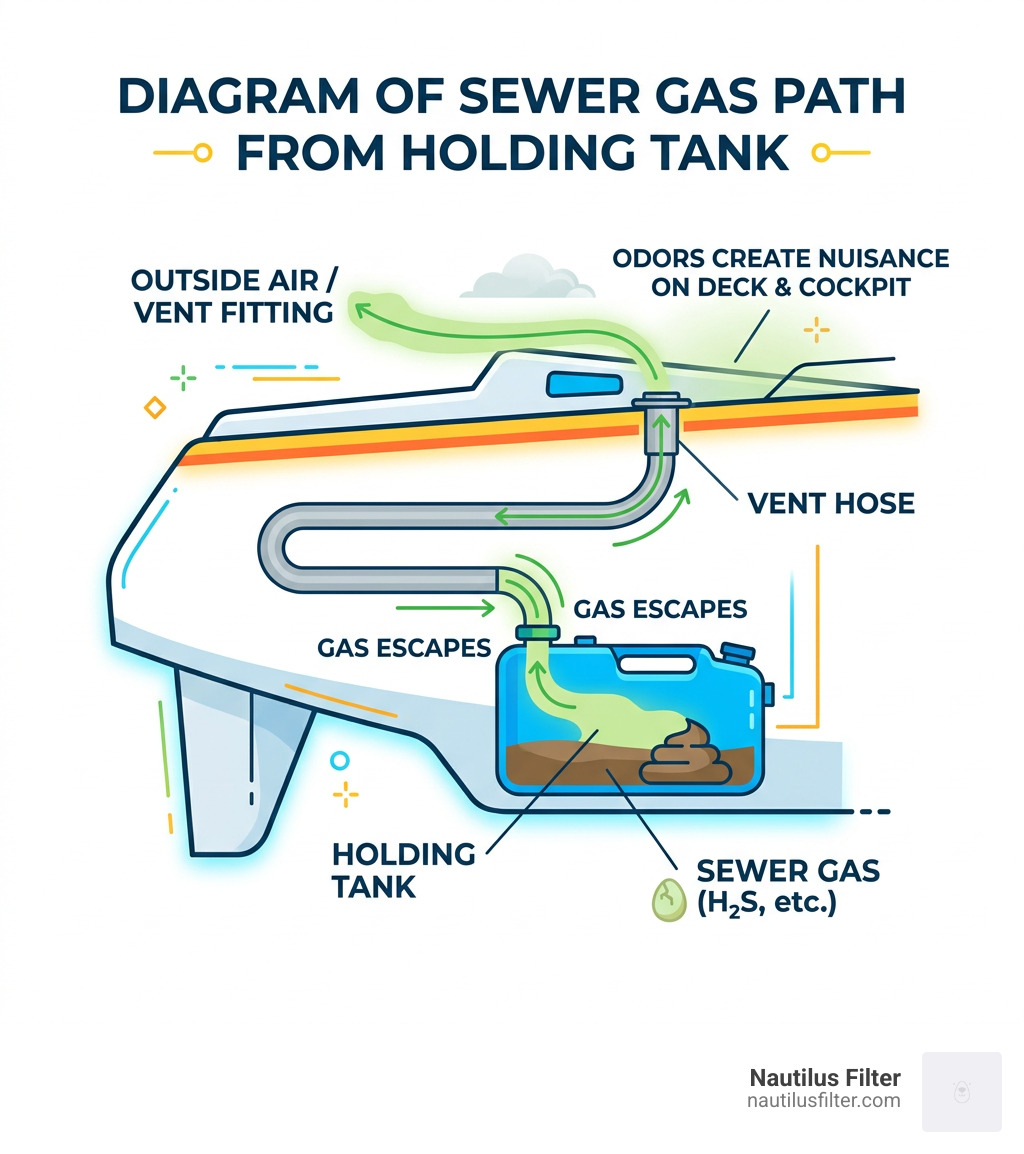
To solve the problem, we first have to understand the chemistry happening inside that plastic or aluminum box. A holding tank isn't just a container; it’s a biological reactor. As soon as organic matter enters the tank, bacteria begin the process of decomposition.
The primary culprit for that "rotten egg" smell is hydrogen sulfide (H₂S). This gas is a byproduct of bacterial metabolism. Along with H₂S, these microbes produce methane (which is odorless but flammable) and ammonia (which has its own sharp, pungent scent).
While we often think of these smells as just a nuisance, they can actually be a health concern. According to Scientific research on the health risks of sewer gas, hydrogen sulfide is toxic in high concentrations and can cause respiratory irritation, headaches, and dizziness even at lower levels. In the confined spaces of a boat, ensuring these gases are properly managed isn't just about comfort — it's about safety.
There are two main types of bacteria at work in your sanitation system: aerobic and anaerobic.
In most boat holding tanks, the environment naturally becomes anaerobic because there isn't enough airflow to support aerobic life. The deeper the waste pile and the less ventilation the tank has, the more these anaerobic colonies flourish, pumping out H₂S every time you flush.
If you’ve noticed that your boat smells significantly worse in July than it does in October, you’re seeing the direct impact of temperature on bacterial activity.
Research into Understanding septic tank odor control shows that the ideal temperature range for bacterial activity in waste systems is roughly 45 to 85 degrees Fahrenheit. Within this window, bacteria are highly active. However, as temperatures climb toward the higher end of that range — common during a Pacific Northwest summer in Anacortes or Seattle — the rate of decomposition accelerates.
Heat acts like an incubator. It speeds up the "eating and farting" process of the anaerobic bacteria, leading to a rapid buildup of gas. Furthermore, warm air is less dense and rises more easily, helping to carry those foul-smelling gases out of the tank and into your living space or across the deck.
Sometimes, the smell isn't just about biology; it’s about a breakdown in the system's hardware. Even a biologically "healthy" tank will smell if the gases aren't going where they're supposed to.
Your holding tank has a vent line for a reason. Every time you flush the toilet, a volume of water and waste enters the tank. That volume has to displace an equal amount of air. If the vent is working correctly, that stinky air is pushed out through a thru-hull fitting on the side of the hull.
However, if the vent is clogged — often by a spider’s nest, salt crust, or waste from an overfilled tank — that air has nowhere to go. This creates pressure inside the tank. Eventually, that pressure will find the path of least resistance, which is often back up through the toilet seals or the sink drains.
Conversely, when you pump out the tank, a vacuum is created. If the vent is blocked, the pump-out station can actually suck the air out so hard that it collapses the tank or pulls the water out of your P-traps, leaving an open highway for sewer gas to enter the cabin.
One of the most common mistakes boaters make is being too "conservative" with flush water to save space in the tank. This is a recipe for disaster.
Without enough water, solid waste and toilet paper don't break down; they sit in a pile directly under the discharge pipe. Over time, this pile dries out and hardens, forming what the industry calls a "poo pyramid." This pyramid blocks the flow of waste and provides a massive, high-surface-area home for anaerobic bacteria to produce odors.
| Symptom | Black Tank (Sewage) |
|---|---|
| Primary Odor | Rotten eggs (H2S), Ammonia |
| Source | Human waste, toilet paper |
| Common Cause | Anaerobic bacteria, poo pyramid |
| Fix | Vent filtration, more water |
Before you start throwing chemicals at the problem, you need to find the source. We recommend a systematic approach to diagnosis:
If your hoses are fine and your seals are tight, but you still smell sewage on deck or in the cockpit, the problem is the vent. Remember: H₂S gas must exit the tank through the vent hose. This is a mechanical reality of how tanks work.
Internal tank treatments — like enzymes, bio-additives, or liquid sanitizers — aim to reduce the production of odor inside the tank. While these can help, they rarely eliminate 100% of the gas. Even a small amount of H₂S is enough to ruin a sunset dinner in the cockpit.
This is where activated carbon vent filters come in. Instead of trying to stop the bacteria from "farting," a vent filter acts as a gas mask for your boat. It is installed inline on the vent hose. As the stinky air is pushed out of the tank during a flush or due to heat expansion, it passes through a bed of activated carbon. The carbon molecules "adsorb" the H₂S, trapping it before it can reach the outside air.
Many boaters reach for bleach or formaldehyde-based treatments. We strongly advise against this for several reasons:
No. Bleach is caustic and kills the beneficial microbes that help break down solids. It can also damage your sanitation hoses and seals. Most importantly, it is a temporary fix that does nothing to address the gas escaping through the vent line.
For a weekend boater in the Pacific Northwest, pumping out every time you return to the dock is best practice. For liveaboards in areas like Vancouver or Seattle, the usage intensity is much higher. Liveaboards should pump out at least weekly to prevent the waste from becoming highly concentrated and overly anaerobic.
The secret to a truly odor-free boat isn't a "magic" liquid you pour down the drain; it's a mechanical solution that captures gas at the source. At Nautilus Filter, we've engineered the definitive fix for vent odors.
The Nautilus Filter installs inline on your holding tank vent hose and adsorbs H₂S before it reaches the outside air. Unlike conventional single-chamber filters that often saturate quickly and need to be thrown away, our filter features a patent-pending Carbon Helix Five-Chamber design. This innovation delivers 6x the odor removal performance and lifespan of standard filters by forcing the gas through five sequential stages of proprietary, H₂S-targeting activated carbon.
We also addressed the two biggest complaints boaters have about vent filters: cost and safety.
Whether you are a weekend cruiser in Anacortes or a full-time liveaboard in Vancouver, the Nautilus Filter is designed to handle the high usage intensity of real-world boating. Our kits come with everything you need for a complete install, including 316 stainless steel hardware and hose barb discs for 5/8" and 3/4" hoses.
Stop fighting biology and start using physics. See the Nautilus Filter at nautilusfilter.com/products/nautilus-filter-kit and watch our easy installation guide at nautilusfilter.com/install. Order today and enjoy free shipping on orders over $50.


