


Marine Holding Tank Odor Control for a Happy Crew
, by Marc Buccat, 9 min reading time
, by Marc Buccat, 9 min reading time
Learn how to stop holding tank odor with ventilation, additives, maintenance & Nautilus filters for odor-free boating.
How to stop holding tank odor is one of the most searched questions among boat owners — and for good reason. The smell comes back season after season, even after chemical treatments, pump-outs, and every tip from the marina bulletin board.
Here's a quick overview of the most effective ways to control holding tank odor:
You know the smell. It hits you on a warm afternoon in the cockpit. Sometimes it drifts down to the dock. On bad days, your guests notice it before you do. You've tried tank treatments. You've dumped more frequently. The smell keeps coming back.
The frustration is real — and it's common. What most boaters don't realize is that the odor isn't just coming from the tank. It's escaping through the vent hose as hydrogen sulfide gas (H₂S), a byproduct of anaerobic waste breakdown. Chemical treatments can slow gas production inside the tank, but they don't stop the gas from traveling out through the vent line into the air around your boat.
Understanding where the odor escapes — and why — is the first step to actually solving the problem for good.
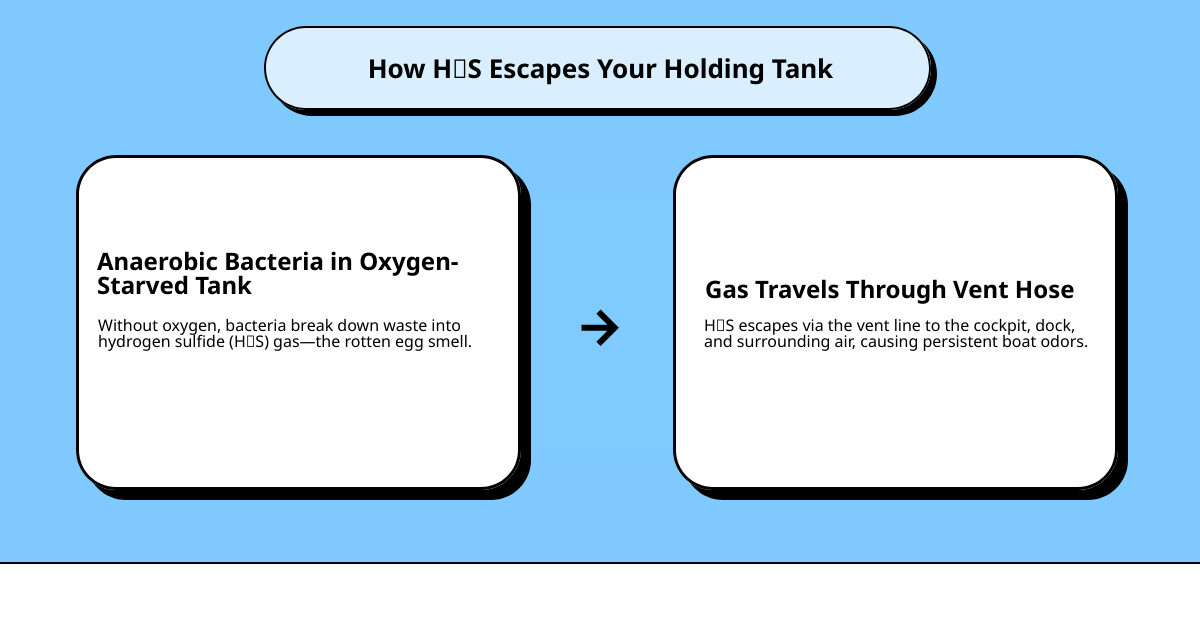
To understand how to stop holding tank odor, we have to look at the biology happening inside that plastic or aluminum box. Most holding tanks are oxygen-deprived environments. In these conditions, anaerobic bacteria thrive. As they break down waste, they produce hydrogen sulfide (H2S) gas—the classic "rotten egg" smell—along with methane and other pungent organic compounds.
According to Practical Sailor research on odor control, the goal is to shift the tank from an anaerobic state to an aerobic one. Aerobic bacteria produce much less odor, but they require oxygen to survive. When a tank is sealed and poorly vented, the "stinky" bacteria take over.
Heat is a major amplifier of this process. High temperatures cause water to evaporate, exposing solid waste and energizing odor molecules so they vaporize more easily into the air. Furthermore, while beneficial aerobic bacteria tend to slow down in extreme heat, anaerobic bacteria often thrive, releasing gases at an accelerated rate.
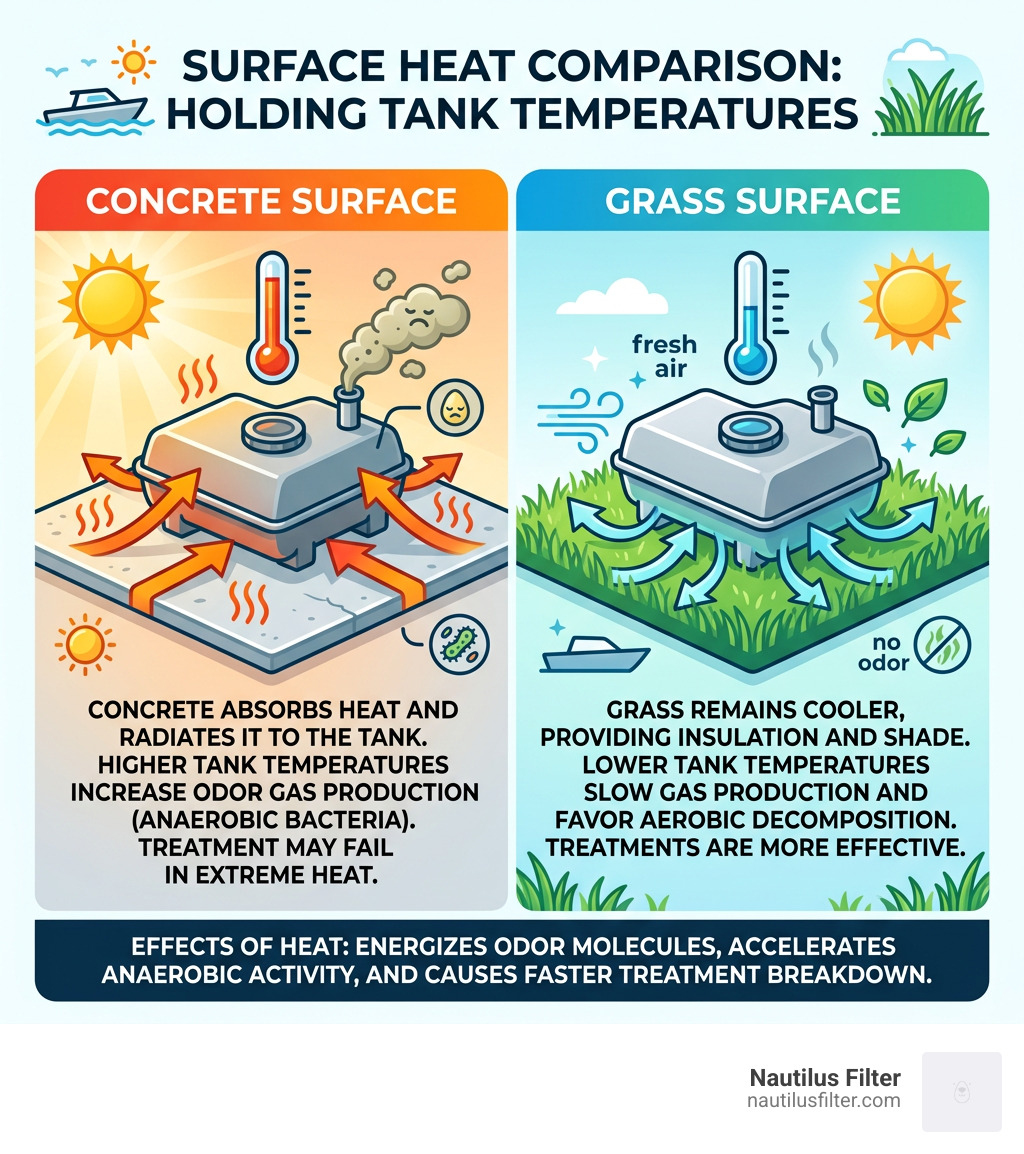
Research shows that if you are parked or docked where the sun hits the hull or pavement, tank temperatures can nearly match the ambient air. If it is 95 degrees outside, your tank is likely too hot for standard bacterial treatments to keep up. In the Pacific Northwest, from Seattle to Vancouver, we might not see 95 degrees every day, but even a 75-degree afternoon can bake a dark hull enough to kick gas production into high gear.
Ventilation is the most critical mechanical factor in odor control. If your tank can "breathe," oxygen enters the system, encouraging aerobic breakdown and allowing gases to dissipate safely. However, most factory-installed vent systems are undersized.
To ensure proper airflow, follow these specifications:
Airflow dynamics are simple: air needs to move in and out. Some owners install "mushroom" style thru-hulls instead of restrictive slit-style vents to increase intake. Others utilize scientific research on vent line rise and length to implement dual-venting systems. By placing vents on opposite sides of the hull, you create a cross-flow effect that pulls fresh air through the tank constantly, even when the boat is at rest. For larger tanks or persistent issues, active aeration—using a small bubbler or fan—can force the aerobic environment that bacteria need to stay quiet.
A clean tank is a happy tank. We recommend flushing the system with fresh water every time you pump out. While it’s tempting to use raw lake or sea water, salt water reacts with organic waste to create even more H2S due to sulfate-reducing bacteria.
Frequent pump-outs prevent the buildup of "sludge" at the bottom of the tank. If you are a liveaboard in Anacortes or Vancouver, your tank works much harder than a weekend cruiser's. Agitating the tank by taking the boat out for a sail or a run in the sound can help break up solids, making them easier to evacuate during your next visit to the pump-out station.
Not all tank treatments are created equal. In fact, some of the most common "old school" solutions actually make the problem worse in the long run.
If you have addressed the tank chemistry and the vent but the smell persists inside the cabin, you likely have a mechanical leak.
Common failure points include:
When mechanical ventilation and biological treatments aren't enough to stop the smell from reaching the cockpit or your neighbors on the dock, it’s time for a professional-grade filter. This is where we at Nautilus Filter specialize.
Most standard vent filters use a single chamber of carbon-impregnated foam. These often saturate quickly and need to be thrown away entirely—a costly and wasteful cycle. We designed the Nautilus Filter to be the final word in vent odor control.
Our Nautilus Filter Kit details highlight our patent-pending Carbon Helix five-chamber design. By forcing the H2S gas through five sequential stages of our proprietary activated carbon blend, we achieve up to 6x the odor removal performance and lifespan of conventional filters.
One of the biggest risks with vent filters is a "clog" that leads to tank collapse during a high-powered pump-out. We solved this by including a silicone bypass valve—a safety feature not found in conventional vent filter designs. This valve allows air to bypass the carbon media if the pressure differential becomes too high, protecting your plumbing.
Best of all, the Nautilus Filter is refillable. You don't throw the hardware away every year. When the carbon is spent, you simply open the canister and swap in a Carbon Refill Kit. It’s better for your wallet and better for the waters of the Pacific Northwest. See the Nautilus Filter at nautilusfilter.com and watch the install video at nautilusfilter.com/install.
As we’ve seen, heat is a catalyst. It accelerates the growth of anaerobic bacteria and increases the vapor pressure of the waste. In humid environments like Seattle or Vancouver, the air holds onto these odor molecules longer, making the "funk" feel much more thick and persistent.
We strongly advise against it. Bleach is a harsh oxidizer that destroys the beneficial aerobic colonies you’re trying to build. Furthermore, it can dry out and crack the expensive rubber seals in your pump and joker valves, leading to even more leaks and smells.
With a refillable system like ours, we recommend replacing the media once per season for recreational boaters. For liveaboards, who put significantly more "cycles" through their system, a mid-season refill ensures that H2S is always being adsorbed before it reaches the cockpit.
Controlling boat odors requires a multi-pronged approach: biology, maintenance, and mechanical filtration. For the high-intensity needs of liveaboards and serious cruisers, relying on chemicals alone is rarely enough. By establishing an aerobic environment and using a high-performance filter, you can ensure your time on the water is spent enjoying the breeze, not managing the "funk."
If you are ready for a permanent mechanical fix, the Carbon Helix technology in our refillable system offers the most effective and sustainable path forward. Order the Nautilus Filter Kit at nautilusfilter.com and give your crew the fresh air they deserve.


