

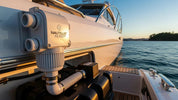
Fresh Air at Sea: A Guide to Vent Filters and Odor Control
, by Marc Buccat, 11 min reading time
, by Marc Buccat, 11 min reading time
Discover how holding tank vent filters eliminate odors, prevent clogs, and optimize airflow for fresh air on your boat.
Holding tank vent filters are inline carbon filters installed on your boat's holding tank vent hose to capture hydrogen sulfide (H₂S) and other foul-smelling gases before they reach outside air.
Quick answers for buyers:
There's a particular kind of frustration that comes with a holding tank odor problem. You've tried the chemical treatments. You pump out regularly. But on a warm afternoon, that unmistakable smell still drifts across the cockpit — or worse, up from the dock while your neighbors walk past. This isn't just a minor annoyance; it's a social liability. When you're moored in a tight marina in Anacortes or Vancouver, the air is often still. That "rotten egg" smell of hydrogen sulfide doesn't just dissipate; it lingers around your hull and drifts into the open ports of the boat next to you. It changes the way you interact with your neighbors and can even make you hesitant to invite guests aboard for a sunset drink.
The smell isn't coming from the toilet. It isn't coming from a spill. It's coming from the vent.
Every time waste breaks down in a sealed holding tank, it produces hydrogen sulfide gas. That gas has to go somewhere. It travels up the vent hose and exits through the thru-hull fitting — right into the air around your boat. Hydrogen sulfide is particularly insidious because the human nose can detect it at concentrations as low as 0.5 parts per billion. By the time you can smell it, the gas is already well-concentrated. Chemical treatments can slow H₂S production inside the tank, but they don't stop the gas from escaping through the vent.
That's the gap a vent filter is designed to close.
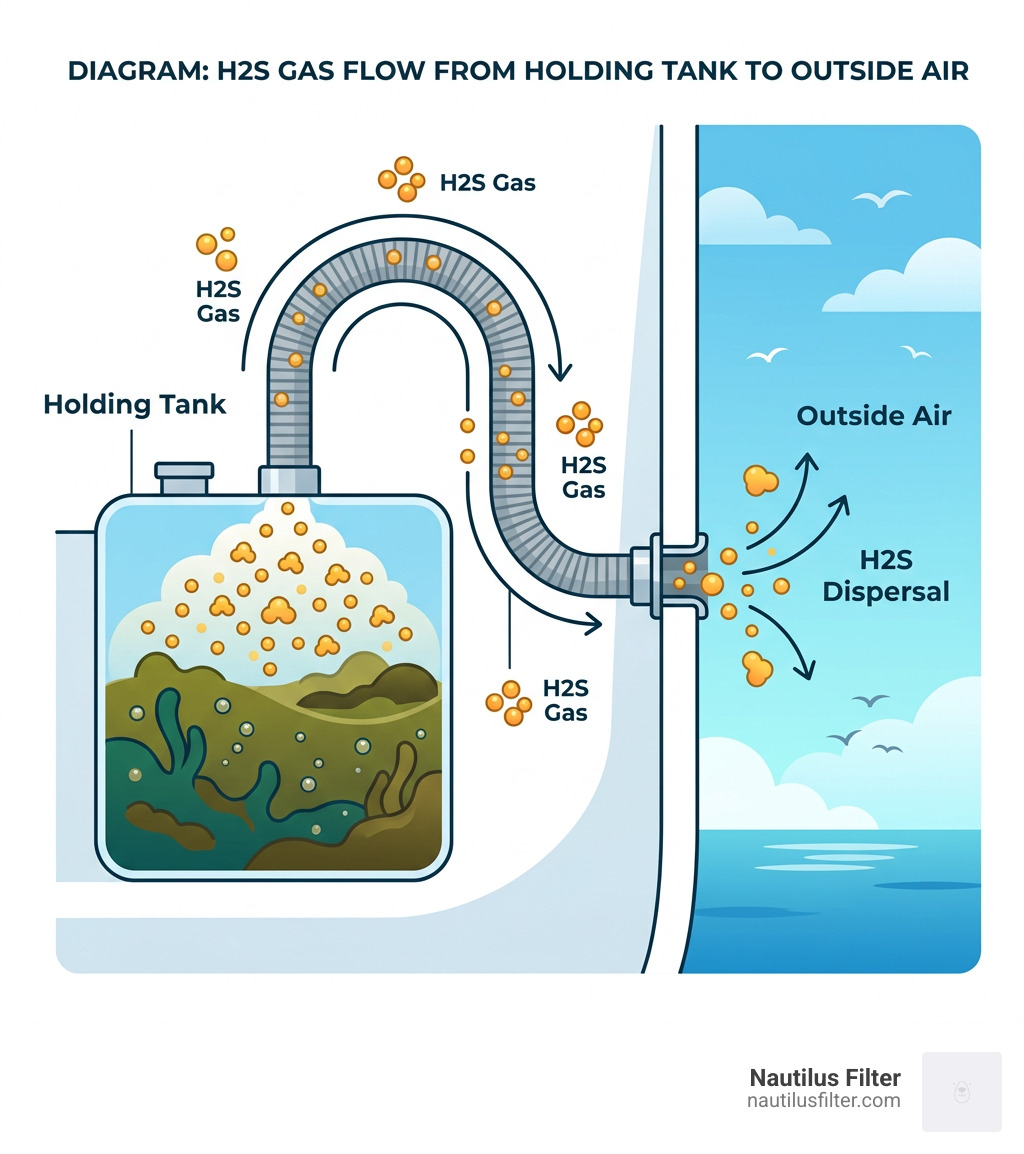
If you’ve ever noticed a "puff" of foul air when someone flushes the head, you’ve experienced the displacement of gas. As waste enters the tank, an equal volume of air must exit through the vent line. Without a filter, that air carries concentrated H₂S—a gas detectable by the human nose at sub-part-per-million levels. On a boat, this often manifests as a "phantom" smell that seems to come and go with the breeze, making it difficult to pin down until you realize it's perfectly synced with every flush of the head.
Holding tank vent filters act as a molecular gatekeeper. Most filters utilize activated carbon, a material processed to have small, low-volume pores that increase the surface area available for adsorption. Adsorption is different from absorption. While absorption involves a substance being soaked up into the bulk of a liquid or solid (like water into a sponge), adsorption is a surface-based process. The gas molecules are physically trapped on the surface of the carbon.
The science behind this is fascinating. According to Scientific research on carbon's catalytic self-regeneration in marine environments, carbon doesn't just "fill up" like a sponge. In the presence of fresh air (oxygen), a catalytic reaction can occur where H₂S is converted into elemental sulfur and water. This "self-regeneration" allows high-quality carbon filters to last significantly longer than simple lab tests might suggest, provided the filter has enough volume for the reaction to take place. Activated carbon is essentially a material with an incredibly high internal surface area—one gram can have a surface area in excess of 3,000 square meters. This means a single filter contains the equivalent of several football fields of "sticky" surface area for odor molecules to cling to.
To truly solve boat odors, we have to look at the biology inside the tank. In her definitive book Get Rid of Boat Odors, expert Peggie Hall explains that the "stink" is caused by anaerobic bacteria. These bacteria thrive in environments without oxygen and produce sulfur dioxide, methane, and the dreaded hydrogen sulfide. Anaerobic bacteria are the "villains" of marine sanitation. In the absence of oxygen, these microorganisms break down organic matter through fermentation, releasing not just H2S, but also volatile organic compounds (VOCs) and mercaptans—the same chemicals added to natural gas to give it a warning smell.
Conversely, aerobic bacteria—which need oxygen—produce odorless carbon dioxide (CO2). This is why ventilation is so critical. If a tank is well-oxygenated, the odor-producing bacteria are crowded out. By understanding that odor is a biological byproduct, we can see why a two-pronged approach—maximizing oxygen and filtering the exhaust—is the only way to achieve a truly "scent-free" boat.
| Feature | Aerobic Bacteria | Anaerobic Bacteria |
|---|---|---|
| Oxygen Required | Yes | No |
| Byproduct Gases | Carbon Dioxide (Odorless) | Hydrogen Sulfide, Methane (Stinky) |
| Odor Level | Low to None | High / Sewage Smell |
| Preferred Environment | High Airflow / Aerated | Stagnant / Sealed |
For more deep dives into the biology of your boat's plumbing, check out the Nautilus Filter Blogs News.
While the concept of a filter is sound, traditional designs often create as many problems as they solve. Many boaters in the Pacific Northwest have experienced the "tank collapse" or "clogged vent" nightmare. In our region, we also face the challenge of "vent icing" or salt crystallization. When moist air from the tank meets the cold exterior air in the vent line, condensation forms. If this moisture gets trapped in a traditional filter's carbon bed, it creates a thick, muddy barrier.
The primary argument against holding tank vent filters by experts like Peggie Hall is that they restrict airflow. A standard 5/8-inch or 3/4-inch vent line is already narrow; adding a dense bed of charcoal can act like a plug. This restriction prevents oxygen from entering the tank, which promotes the very anaerobic bacteria that cause the smell.
More dangerously, if a vent is restricted during a high-speed pump-out, the vacuum can actually implode a plastic holding tank. During a pump-out, the shore-side vacuum pump moves a massive volume of air and liquid very quickly. If your vent filter is clogged or too restrictive, the pump will pull a vacuum on the tank itself. Since most plastic holding tanks are designed for internal pressure, not external vacuum, they can collapse inward like a crushed soda can. This often leads to structural failure, leaking seams, and a repair bill that can easily reach thousands of dollars.
Traditional filters are often "disposable" plastic tubes. Once the charcoal is saturated or—worse—wet, the filter is useless. If you overfill your tank and waste enters the vent line, the charcoal becomes a soggy, blocked mess. In northern climates like Seattle or Vancouver, where we deal with moisture and temperature swings, these filters can fail prematurely. Most manufacturers suggest an annual replacement, but for liveaboards, a single-chamber filter might only last a few months before "odor breakthrough" occurs.
Before installing a filter, we recommend ensuring your vent system is as efficient as possible:
At Nautilus Filter, we knew there was a better way to handle these challenges. We designed a system specifically for the rigors of the Pacific Northwest boating season. The Nautilus Filter Kit features a refillable architecture. Instead of throwing away a large plastic cartridge every year, you simply replace the internal media. This saves you $40–80 annually and keeps plastic out of our oceans.
Why the Nautilus Filter is different:
For most recreational boaters in the Pacific Northwest, we recommend replacing the carbon media annually at the start of the season. However, for liveaboards or those in warmer waters, semi-annual refills may be necessary. You’ll know it’s time for a refill when you notice odor breakthrough at the thru-hull. Because the Nautilus Filter uses high-grade pelletized carbon rather than foam or fabric, it provides a much denser field of "traps" for these molecules to encounter.
Yes, many of our customers find they can significantly reduce or eliminate harsh chemical treatments. By using a high-performance filter, you manage the gases that do form, allowing you to focus on tank oxygenation rather than masking smells with perfumes. This approach is better for the environment and better for your boat's plumbing system.
In a traditional filter, an overfill means you must buy a brand-new unit because the charcoal becomes a "wet brick" that prevents the tank from breathing. With the Nautilus Filter, you simply wash out the housing and replace the carbon media. Our internal valve system also provides an extra layer of protection for the carbon bed. Because you only need to replace the carbon and not the entire assembly, the "cost" of an accidental overfill is significantly lower, and you can be back in service in minutes.
A smelly boat isn't just an inconvenience; it's a barrier to enjoying your time on the water. While traditional holding tank vent filters have earned a mixed reputation due to airflow issues and high replacement costs, the Nautilus Filter solves these problems with engineering.
Our refillable system is the most economical and effective choice for boaters in Seattle, Anacortes, and beyond. With our Carbon Helix technology and 316 stainless steel construction, you get a permanent solution to a temporary problem.
Ready to breathe easy? Shop the Nautilus Filter Kit today and experience 6x the performance of standard filters. You can also watch our easy installation video to see how simple it is to upgrade your boat's livability.


