


Hydrogen Sulfide Solutions for a Fresh-Smelling Bilge
, by Marc Buccat, 13 min reading time
, by Marc Buccat, 13 min reading time
Eliminate boat sulfide smell with proven solutions for H2S odors in bilges, holding tanks & plumbing. Expert tips & Nautilus Filter strategies!
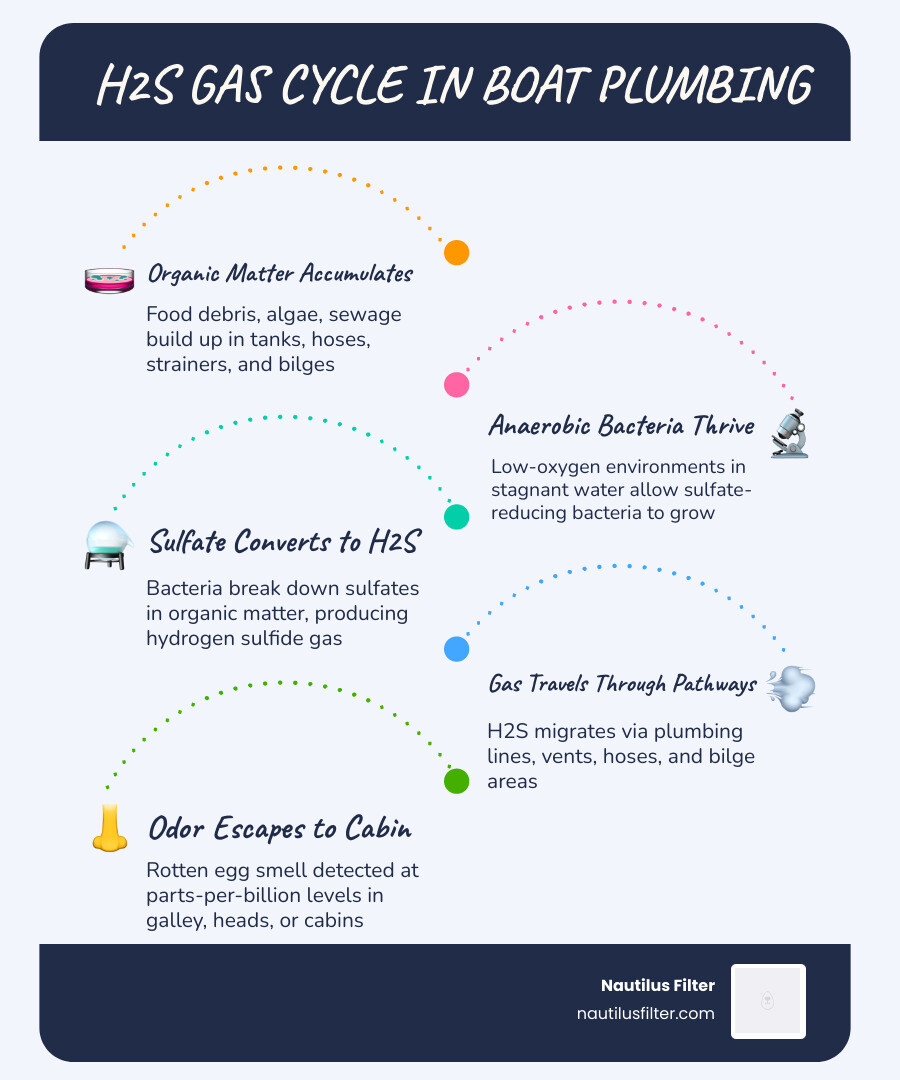
Eliminating boat sulfide smell starts with understanding what you're actually dealing with: hydrogen sulfide gas (H₂S), produced when anaerobic bacteria break down organic matter in your boat's plumbing, tanks, and bilge.
Quick answer — the most common sources and fixes:
| Source | Likely Cause | First Step |
|---|---|---|
| Fresh water tank | Bacterial growth, stagnant water | Bleach shock treatment |
| Hot water heater | Failed anode rod | Inspect and replace anode |
| Seawater intake / raw water strainer | Decomposing organic matter in hose | Flush and disinfect |
| Holding tank vent | H₂S gas escaping through vent line | Install a carbon vent filter |
| Sanitation hoses | Odor permeation through hose walls | Hot-rag test, replace if saturated |
| Bilge | Anaerobic decomposition, standing water | Clean with hot soapy water, improve drainage |
Here's what makes this smell so maddening: H₂S is detectable by the human nose at concentrations in the parts per billion range. That means even a tiny source — a neglected strainer, a slow vent leak, a deteriorating hose — is enough to ruin a day on the water.
The smell is unmistakable. It hits you the moment you open the cabin door or step onto the dock beside your slip. You've probably tried chemical treatments, extra flushing, or air fresheners. They help temporarily. But if the underlying source keeps producing H₂S, the smell keeps coming back.
This guide walks through every major source of sulfide odor on a boat — from fresh water tanks and hot water heaters to raw water strainers, sanitation hoses, and holding tank vents — with specific, actionable fixes for each.
Before we start scrubbing, we need to play detective. On a boat, smells travel through the strangest pathways. You might smell sulfur in the galley and assume it’s the sink drain, only to find the culprit is a stagnant raw water intake five feet away.
To eliminate boat sulfide smell, we first have to isolate which system is "gassing off." Hydrogen sulfide is a byproduct of anaerobic decomposition—meaning bacteria are eating organic matter in an environment without oxygen. This happens in several places on a boat, from the bottom of your fresh water tank to the dark corners of your bilge.
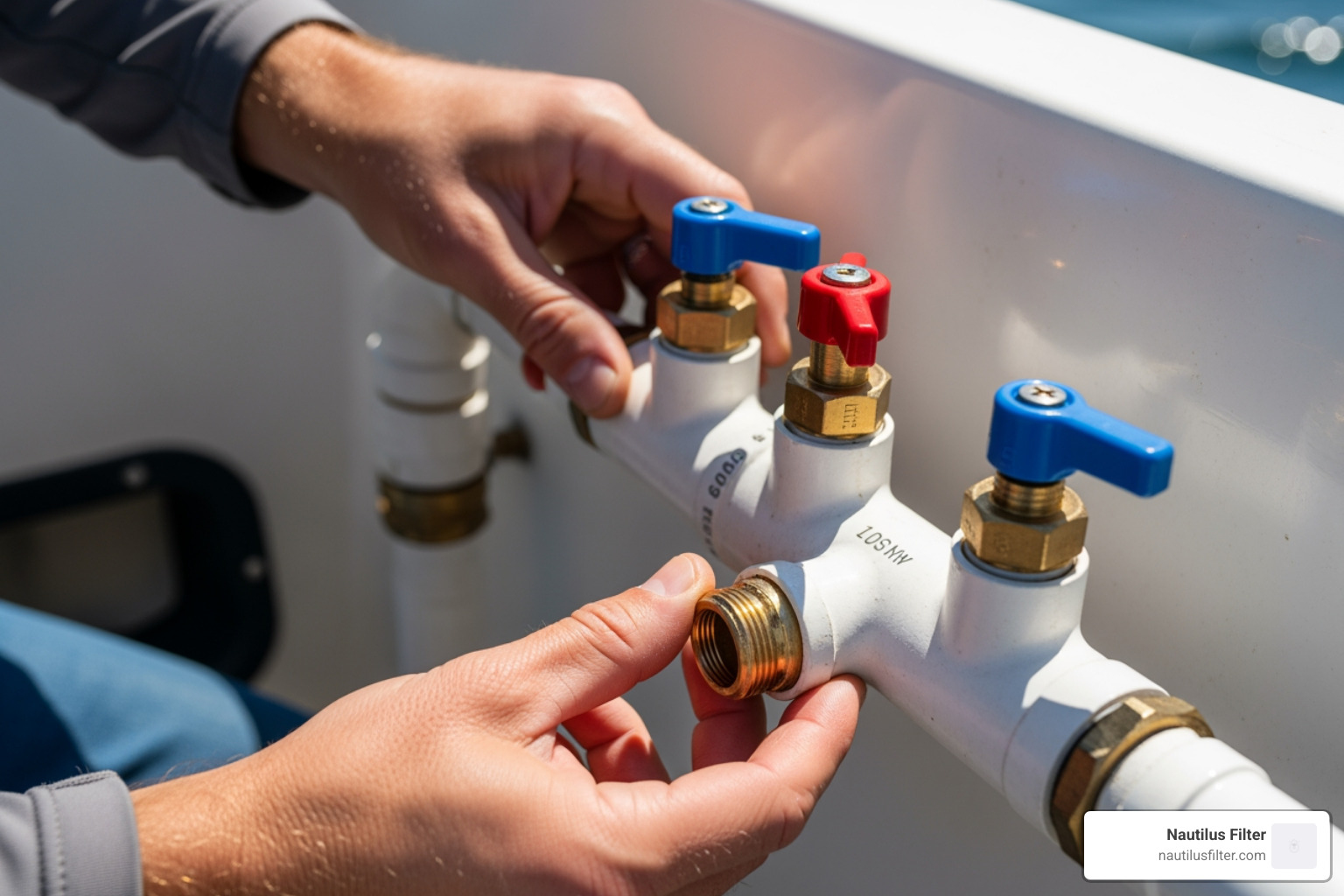
If you turn on the tap and get a face-full of rotten eggs, the problem is in your potable water. Here is how we narrow it down:
In the Pacific Northwest, we see this often when boats sit through a mild, rainy winter in Seattle or Anacortes. Stagnant water is a playground for algae and bacteria. Even if the water was clean when you filled it, tiny amounts of organic matter can lead to a massive "bloom" that produces that signature sulfur stench.
Sometimes the smell isn't in the water you drink, but in the water that stays in the boat.
If you are in an area with poor water turnover, like some crowded marinas in Vancouver or Seattle, you might even be sucking in "pre-contaminated" water. You can Report odor problems if you suspect local water quality issues, but usually, the fix starts on your own hull.
The most intense source of sulfide gas is, unsurprisingly, the sanitation system. This is where the "rotten egg" smell transitions from an annoyance to a social emergency.
Many boaters reach for "blue" or "green" liquid treatments to stop the stink. While these products can help break down solids or mask odors inside the tank, they often fail to eliminate boat sulfide smell for one simple reason: they don't stop the gas from escaping.
Your holding tank is a living ecosystem. Even with the best biological treatments, the process of breaking down waste produces gas. As the tank fills, that gas has to go somewhere. It travels up the vent hose and out the through-hull fitting. If you're sitting in the cockpit on a hot afternoon and the wind shifts, you'll know exactly when someone flushes.
Chemicals are a surface treatment; they don't address the gas that has already formed and is sitting in the "headspace" of the tank or the vent line.
If the smell is coming from your head intake, we recommend a two-step approach. First, clean the raw water strainer. Empty it, scrub it with detergent, and consider a soak in oxygen-based bleach (which is less corrosive to your metal fittings than chlorine).
Second, check your hoses. Sanitation hoses have a lifespan. Over time, the plastic or rubber becomes permeated with odorous molecules.
The Hot-Rag Test:
If the rag smells like the hose, the hose has "permeated." No amount of cleaning will fix this; the smell is literally trapped inside the hose wall. It’s time to replace it.
Once you've identified the source, it's time for the "Search and Destroy" mission. To truly eliminate boat sulfide smell, we have to be methodical.
If your fresh water smells like sulfur, you need to shock the system. We recommend using household bleach (5% sodium hypochlorite).
The Bleach Shock Procedure:
The Anode Rod Factor: If the smell is only in the hot water, your water heater's magnesium or aluminum anode rod is likely the culprit. These rods are designed to corrode so your tank doesn't have to. However, in certain water conditions (especially soft water), they can react with bacteria to produce H₂S gas.
For the bilge and strainers, the goal is to remove the "parent material" (the muck).
Cleaning is great, but we want to prevent the smell from ever returning. This requires a combination of good habits and the right hardware.
When it comes to holding tanks, the most effective way to eliminate boat sulfide smell is to catch the gas before it leaves the boat. This is where a high-quality vent filter becomes essential.
Most boaters don't realize that their holding tank vent is essentially an exhaust pipe for H₂S gas. Standard vent filters often use a single chamber of carbon-impregnated foam. These work for a few months, but they quickly saturate and stop working, usually right when the weather gets warm and the "gassing" increases.
At Nautilus Filter, we've spent years engineering a better solution for the unique challenges of marine sanitation. Our filter uses a patent-pending Carbon Helix Five-Chamber design. By forcing the H₂S gas through five sequential chambers of our proprietary activated carbon blend, we achieve 6x the odor removal performance and lifespan of conventional single-chamber filters.
Why the Nautilus Filter is the smart choice for PNW boaters:
Whether you're a weekend cruiser in Anacortes or a full-time liveaboard in a Seattle marina, the intensity of your tank usage matters. Liveaboards, in particular, produce a constant stream of H₂S. The ROI on a refillable, high-capacity filter like the Nautilus is clear: you get a fresh-smelling boat all year round without the "annual tax" of expensive disposable filters.
The Nautilus Filter installs inline on your holding tank vent hose and adsorbs H₂S before it reaches outside air. Our kit includes all the hardware for a complete install, including hose barb discs for 5/8" and 3/4" hoses. You can see the Nautilus Filter at nautilusfilter.com and watch our easy installation video at nautilusfilter.com/install.
Yes. While the "rotten egg" smell is a great warning sign, H₂S is a potent chemical asphyxiant. At low levels, it’s an irritant. At higher levels, it can actually paralyze your sense of smell (olfactory fatigue), making you think the smell has gone away when the concentration is actually increasing. Always ensure your cabin is well-ventilated if you suspect a major leak, and never stick your head into a confined space (like a deep bilge or tank) where you smell sulfur without proper safety gear.
Bacteria are like us—they get more active when it's warm. Increased temperatures accelerate the metabolic rate of anaerobic bacteria, leading to faster H₂S production. Additionally, warm water holds less dissolved oxygen, which pushes the tank environment further into the anaerobic state that creates the smell. This is why a vent filter that worked in April might fail in July.
Most high-quality sanitation hoses last between 5 and 10 years. However, if you use a seawater flush or if waste sits in the lines for long periods, they can permeate much faster. If your hose fails the "hot-rag test," it needs to go. When replacing, always look for hoses specifically certified for marine waste—standard reinforced water hose will permeate almost immediately.
You don't have to live with a boat that smells like a swamp. By systematically checking your fresh water system, cleaning your bilges and strainers, and addressing the gas escaping from your holding tank vent, you can reclaim your cabin.
The secret to a fresh boat is a two-pronged attack: kill the source through cleaning and maintenance, and capture the remaining gas with a high-performance filter. The Nautilus Filter with its Carbon Helix Five-Chamber design and refillable system is designed to provide long-term, cost-effective relief from the most stubborn odors.
Ready to breathe easy again? Visit us at nautilusfilter.com to learn more about our refillable filters and how we can help you eliminate boat sulfide smell for good. Safe (and sweet-smelling) boating!


