


The Dreaded Holding Tank Odor and How to Kill It for Good
, by Marc Buccat, 10 min reading time
, by Marc Buccat, 10 min reading time
Eliminate boat holding tank odors for good! Diagnose, fix, and prevent persistent smells with ventilation, hose upgrades, and advanced filtration.
Boat holding tank odors are one of the most common — and most frustrating — complaints among boat owners. If you want a quick answer, here's what's causing the smell and where to start:
The most common causes of holding tank odors:
Quick fixes by symptom:
| Symptom | Likely cause | First step |
|---|---|---|
| Smell inside the cabin | Permeated hose or bilge | Paper towel test on hoses |
| Smell outside near stern | H₂S escaping through vent | Inspect/upgrade vent line or add vent filter |
| Smell only when hot | Accelerated bacterial activity | Improve tank ventilation |
| Smell despite new hoses | Tank treatment not working | Switch to anaerobic-compatible treatment |
Most boaters have been there. You're at the dock on a warm afternoon, guests are on board, and there it is — that unmistakable sewage smell drifting across the cockpit. You've tried the chemical treatments. Maybe you've replaced a hose or two. The smell keeps coming back.
The problem isn't that the solutions don't exist. The problem is that most boaters are treating the wrong thing.
Holding tank odors aren't one problem — they're several, often happening at the same time. The smell inside your cabin comes from a completely different source than the smell on your dock. Treating the tank contents won't stop gas from escaping through the vent. And masking odors with chemicals doesn't fix the underlying biology.
This guide walks through every layer of the problem — from diagnosing exactly where your smell is coming from, to the mechanical fixes that actually work long-term.
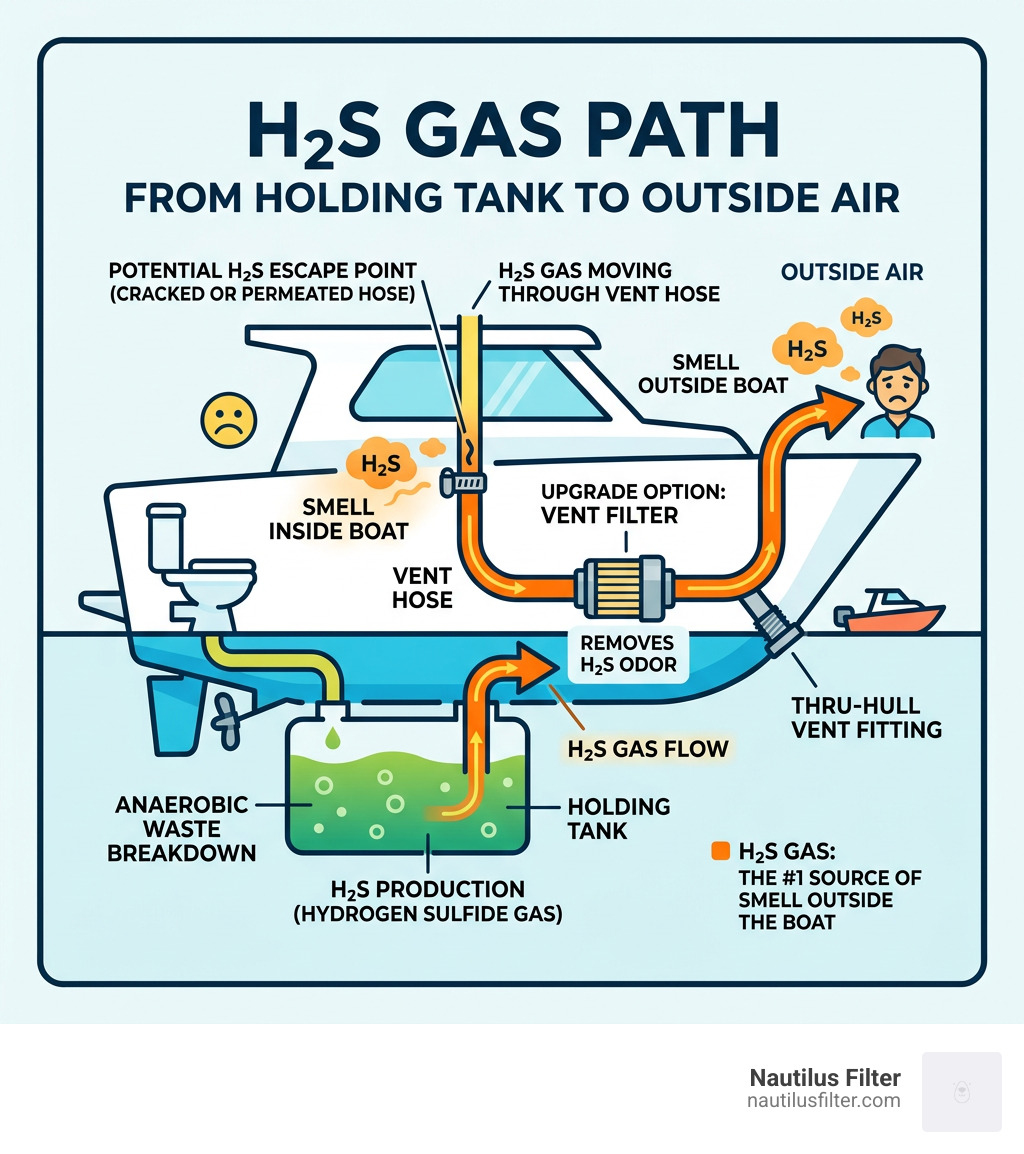
The first step in our battle against boat holding tank odors is to determine exactly where the smell is coming from. If the cabin is unbearable but the cockpit is fresh, we're looking at a different culprit than if the smell only haunts the swim platform.
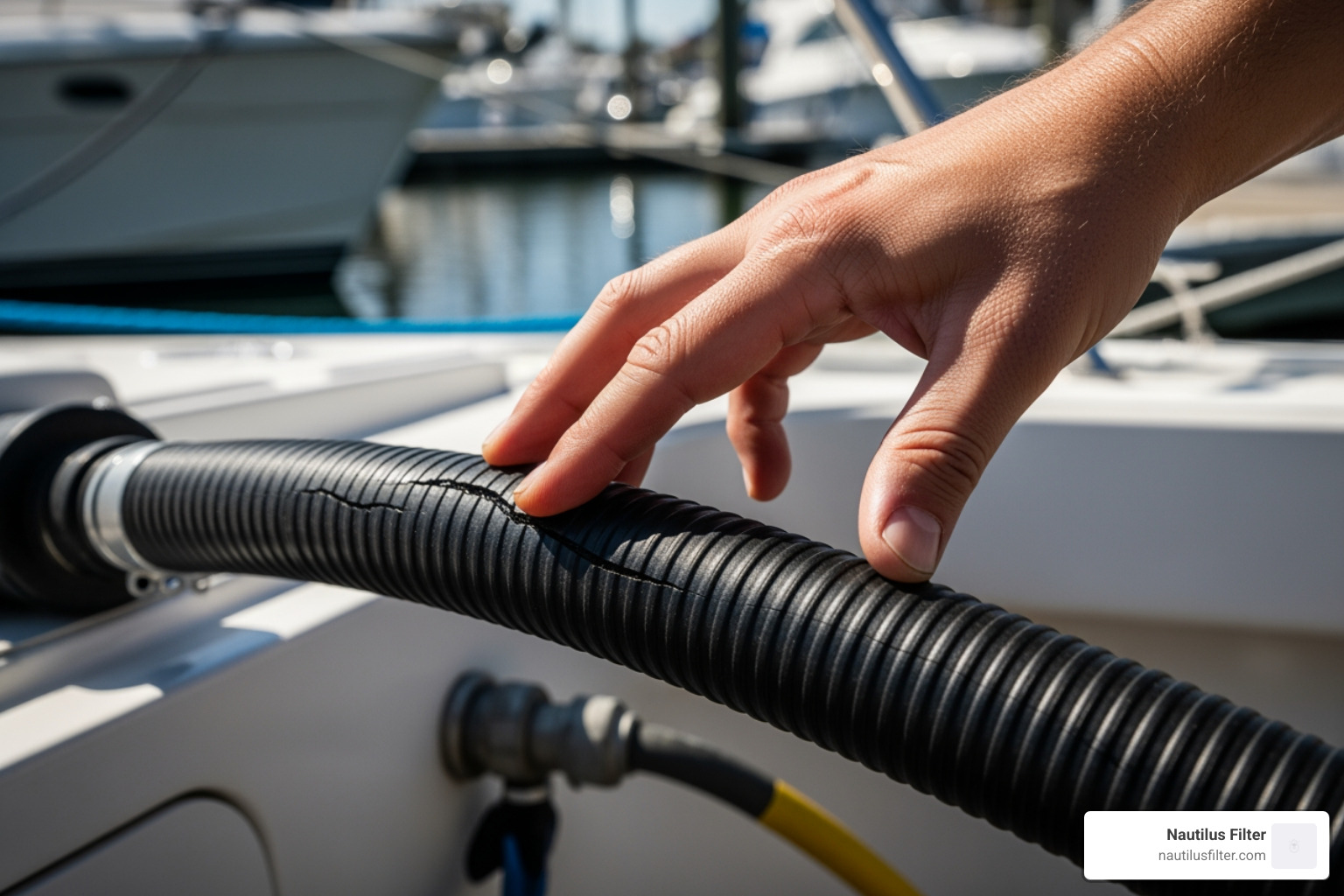
Most odors inside the boat are caused by hose permeation. Standard rubber or low-quality plastic hoses are not truly "smell-proof." Over time, the sewage sitting inside the hose saturates the material, and the odor begins to "bleed" through the wall of the hose into the air.
To identify this, use the wet paper towel test:
If the paper towel smells like the holding tank, your hose has permeated and must be replaced. Other internal sources include bilge contamination from small leaks or raw water microorganisms. When you flush with seawater, tiny organisms trapped in the rim of the toilet bowl die and rot, creating a "swampy" smell that is often confused with the tank itself.
While plastic (polyethylene) tanks rarely permeate, they can certainly leak. We recommend using an inspection mirror to check the top of the tank, especially around the fittings. A common failure point is the tank indicator bulb; if it burns out, you might overfill the tank, causing sewage to seep out of the top vent fitting or inspection port.
For hard-to-find leaks, some professionals use smoke machine testing. By blowing non-toxic smoke into the vent line, you can quickly see if smoke escapes from any cracked fittings or seams in the tank. If you find seepage at a fitting, cleaning the area and sealing it with a high-quality marine sealant like 3M 5200 can often provide a lasting fix.
The biology of your holding tank is the root of the "outside" smell. Most tanks are anaerobic (oxygen-starved) environments. In these conditions, bacteria produce hydrogen sulfide (H₂S)—the classic rotten egg smell—and mercaptans.
To stop the production of H₂S, we need to introduce oxygen. Aerobic bacteria (those that thrive in oxygen) do not produce foul-smelling gases. This is why Practical Sailor testing on tank ventilation emphasizes that a well-vented tank is the best defense.
Switching to fresh water flushing is another game-changer. By removing the sulfate-reducing bacteria found in seawater, you significantly reduce the chemical potential for H₂S production.
Standard factory vent lines are often too small (1/2" or 5/8") and too long. To improve airflow:
If your hoses have failed the paper towel test, there is no "cleaning" them. They must go.
When replacing hoses, don't skimp. We recommend high-quality, odor-impermeable hoses. Look for products that offer a long-term warranty (up to 10 years) against permeation. When installing:
Sometimes the "holding tank smell" is actually a dirty bilge. If you've had a spill or a leak, the area under the tank must be cleaned. We suggest using a garden sprayer to apply a strong detergent, followed by a thorough power wash. Once the area is dry, an odor-eliminating mist like PureAyre can neutralize any lingering molecules. Don't forget to check your AC condensate drains—stagnant water there can smell remarkably like a sanitation issue.
Even with great ventilation, some H₂S gas will always be produced. This gas exits the vent and, depending on the wind, can end up right in your cockpit. This is where a vent filter becomes essential.
The Nautilus Filter solves the problem of H₂S gas by passing it through five sequential chambers of activated carbon. While conventional filters use a single chamber that can quickly saturate, our Carbon Helix technology provides 6x the odor removal performance and lifespan.
Most vent filters on the market are "disposable," meaning you throw away the entire plastic housing every year—a cost of $40–80. The Nautilus Filter is a refillable system. When the carbon is spent, you simply replace the media using a Carbon Refill Kit. This isn't just better for the environment; it’s significantly better for your wallet.
You can find more info about refillable filters on our product page. The kit includes everything needed for a complete installation, including 316 SS hardware and mounting brackets.
A major risk with many vent filters is that they can clog. If the vent is blocked during a high-powered pump-out, the vacuum can actually collapse your holding tank. The Nautilus Filter is the only major system that includes a silicone bypass valve. This valve acts as a vacuum break, protecting your tank's structural integrity if the filter media ever becomes restricted.
To keep your system smelling like... well, nothing... you need a routine.
| Action | Raw Water Flush | Fresh Water Flush |
|---|---|---|
| Odor Potential | High (Rotting organisms) | Low |
| Pump-out Frequency | Every 1-2 weeks | As needed |
| Vinegar Flush | Weekly (Prevents scale) | Monthly |
| Winterizing | Critical (Antifreeze) | Critical |
For liveaboards, the usage intensity is much higher. Sludge buildup is a real concern. We recommend frequent treatments with products that dissolve solids and work in low-oxygen environments. Because liveaboards use their systems daily, the ROI on a permanent fix like the Nautilus Filter is realized almost immediately.
In the Pacific Northwest and similar climates, seasonal changes matter. In the spring, flush your system with a few gallons of fresh water and white vinegar to break up any salt or calcium deposits. Inspect your vent filter media annually; if you start to smell odors outside, it’s time for a refill.
Heat accelerates the metabolic rate of bacteria. Anaerobic bacteria work faster in warm temperatures, producing more H₂S gas. Additionally, gases expand when heated, forcing more odor out of the vent.
No. Bleach kills the "good" bacteria that help break down waste and can damage the rubber valves and seals in your toilet and pump-out system. It also doesn't stop the odor; it just masks it temporarily.
While conventional filters often fail within a single season, the Nautilus Filter’s Carbon Helix design typically lasts much longer. We recommend inspecting it annually and replacing the media every 1-2 seasons depending on usage intensity.
You don't have to live with the "dreaded smell." By diagnosing whether your odor is coming from permeated hoses (inside) or H₂S venting (outside), you can apply the right fix.
The Nautilus Filter is the final piece of the puzzle. With our patent-pending Carbon Helix technology, you get 6x the performance of conventional filters in a sustainable, refillable design. It protects your tank with a built-in bypass valve and saves you money every year on refills.
Ready to kill the odor for good? Order the Nautilus Filter Kit at nautilusfilter.com/products/nautilus-filter-kit and enjoy your boat again. For help with the setup, you can watch our step-by-step guide at nautilusfilter.com/install.


